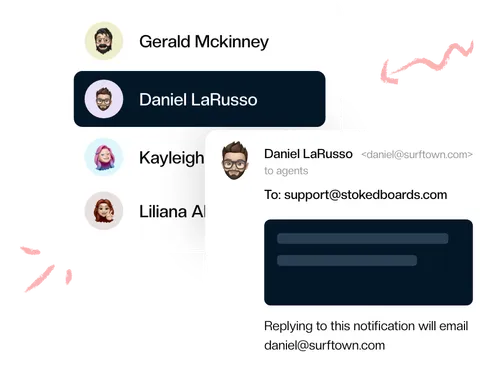
The Google Groups alternative that lives in Gmail
Google Groups is a mailing list. Keeping is a shared inbox that runs inside Gmail and connects to the Google Group you already have.


Rated 4.5 /5 on G2
No Credit Card Required
What Google Groups can't do for a shared inbox
Google Groups is a mailing list with a collaborative-inbox mode added on. Keep it for a discussion list or announcements. If a team answers customer email through it, pick Keeping: it adds assignment, private notes, collision detection and reporting to the group you already have, inside Gmail.

It lives outside Gmail
Collaborative Inbox is a web page at groups.google.com. Your team works a second tab all day, and the Gmail mobile app never sees it.

Replies go out from your own address
By default a member replies from their personal Gmail, not from the group address, and the rest of the group never sees the answer. Two people can reply to the same customer without knowing.

No notes, templates or collision alerts
There is nowhere to leave a private note on a conversation, no shared reply templates, and no warning that a teammate is already answering.

No reporting
No first-response time, no volume per day, no record of who resolved what. You cannot tell whether the team is keeping up until a customer tells you.
Keep your Google Group. Add Keeping on top.
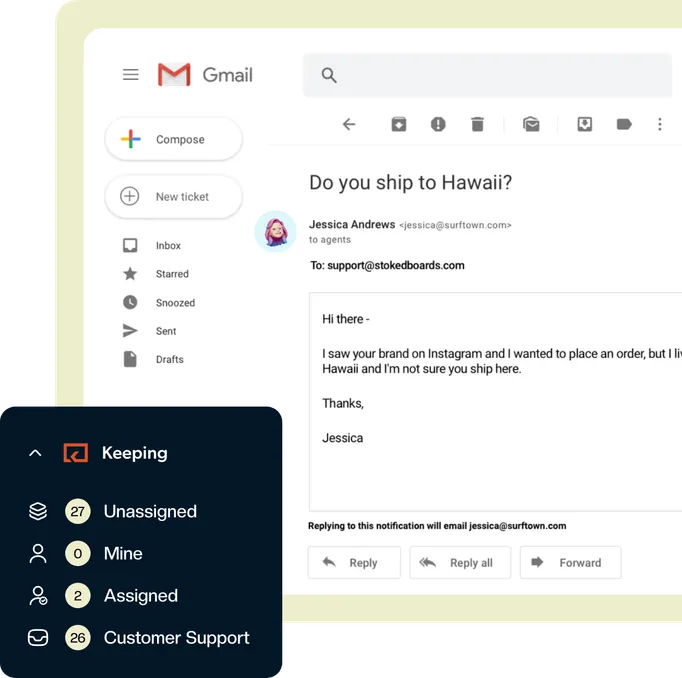
You do not have to migrate anything. Add Keeping as a member of your Google Group and every email sent to the group address shows up in a shared mailbox inside each teammate's Gmail.
Or convert the group to a Google Workspace account and connect it to Keeping with one click. Either way, the address your customers already know stays the same.
 Assign every conversation to one owner and mark it Open, Pending or Closed.
- Leave private notes and @mention a teammate instead of forwarding.
- See who is already replying before you start typing.
- Reply from the shared address, and the whole team sees the reply.

Google Groups vs. Keeping as a shared inbox
Checked against Google's own Collaborative Inbox documentation. Google Groups still wins at what it was built for: a discussion list.
| Features |  | Google Groups |
|---|---|---|
| Works inside Gmail | Yes | NoWeb only, at groups.google.com |
| Replies sent from the shared address | Yes | From each member's own address by default |
| Assign a conversation to one owner | Yes | Collaborative Inbox only, outside Gmail |
| Collision detection | Yes | No |
| Private notes and @mentions | Yes | No |
| Shared reply templates | Yes | No |
| Response-time reporting | Yes | No |
| Automated workflows | Yes | No |
| Works with an existing Google Group | Yes | Yes |
| Discussion forum and mailing list | No | Yes |
| Starting price | $14per user/month | Included with Google Workspace |
| Support when something goes wrong | Email and chat, from people | Workspace admin support and forums |
Everyone sees every reply
In a Google Group, a reply to a customer goes out from the member's own address, and nobody else in the group sees it. The next person to open the thread has no way to know it was answered, so they answer it again.
In Keeping, every reply is sent from the shared address and lands in the shared mailbox for the whole team. Collision detection warns you when a teammate is already typing, and the assignment shows who owns the conversation.
That is the difference between a mailing list and a help desk.

Everything a support team needs, inside Gmail
Keeping adds the help desk features to the Google Group you already run. If you know how to use Gmail, you already know how to use Keeping.

Easy set up
Add Keeping to your Google Group or connect a Workspace address, invite your team, and start answering. Most teams are up in about 15 minutes.
Learn More about Easy set up
Assignment and status
Every conversation has one owner and a status of Open, Pending or Closed, so nothing sits unanswered in the group.
Learn More about Assignment and status
Shared notes
Leave a private note on a conversation and @mention a teammate. No forwarding, no BCC, nothing the customer can see.
Learn More about Shared notes
Multiple mailboxes
Running more than one Google Group? Connect them all and answer each from your own Gmail, with no extra logins.
Learn More about Multiple mailboxes
Advanced reporting
First-response time, resolution time, volume by day and results by agent, tag or mailbox. The numbers Google Groups never gives you.
Learn More about Advanced reporting
Response templates
Getting the same questions again and again? Save the answers once and share them across the team.
Learn More about Response templates
Collision detection
Keeping warns you when a teammate is already replying, so a customer never gets two answers.
Learn More about Collision detection
Confirmation receipts
Tell customers their email arrived with an automatic reply, customised per mailbox. A Google Group's auto-reply is one message for everyone.
Learn More about Confirmation receipts
Other Google Groups alternatives, by what you use it for
Not every team on Google Groups needs a help desk. Pick the replacement for the job the group actually does.
For a mailing list or announcements
Groups.io and Gaggle Mail are purpose-built email lists with archives, digests and moderation. If nobody has to answer the messages, either one does the job, and Google Groups probably already does too.
For team discussion
Slack or Google Chat replace a discussion group with channels and threads. Better for internal back-and-forth, and no use at all for email from customers.
For a support inbox outside Gmail
Help Scout, Front and Drag are shared inbox tools with their own apps. They add assignment and reporting, and they move your whole team out of Gmail to get them.
Compare ticketing toolsFor a support inbox inside Gmail
Keeping connects to your Google Group, adds the help desk features, and your team keeps working in the Gmail they already have open.
See how Keeping connects
Google Groups alternative FAQ
Is Google Groups a shared inbox?
Not by default. A Google Group is a mailing list: every member gets a copy of every message. Turning on Collaborative Inbox adds take, assign and mark-complete actions at groups.google.com, but it stays outside Gmail and has no private notes, collision detection or reporting.
What is the best Google Groups alternative for customer support?
A shared inbox tool that connects to the group you already have. Keeping does that inside Gmail, so nobody learns a new app. Help Scout, Front and Drag are the usual choices outside Gmail. For a plain mailing list, Groups.io or Gaggle Mail are closer to what you use today.
Can I keep my Google Group and use Keeping?
Yes. Add Keeping as a member of the group, or convert the group to a Google Workspace account and connect it to Keeping. Your customers keep writing to the same address, and your team answers from a shared mailbox inside Gmail.
Does Keeping replace Google Groups Collaborative Inbox?
For a support team, yes. Collaborative Inbox gives you assignment and status on a web page outside Gmail. Keeping gives you assignment, status, private notes, shared templates, collision detection, workflows and reporting inside Gmail, on the same group address.
How much does Keeping cost compared to Google Groups?
Google Groups is included with Google Workspace. Keeping starts at $14 per user per month on an annual plan, with a 14-day free trial that requires no credit card.
Our customers love us for a reason
Don’t just take our word for it, see what our customers are saying about us.

Rated 4.5 /5 on G2

“Keeping helps our customer service team stay on top of inquiries & recognize when an issue has been handled.”
“It's a great tool for tracking and sharing support emails with colleagues. I love how Keeping email has its own inbox inside Gmail.”
“Keeping seamlessly integrates with Gmail, so we don't have to work with another tool. It allows everyone to see responses from the team.”
“Seeing our shared mailbox right in GSuite, the automatic setup, and the ability to keep track of issues are my favorite features.”
“At our university, Keeping gives us control over the responses of all our agents, as well as ensuring that all emails are being responded to.”
“Our HR department uses Keeping, and it works amazingly well for us to keep organized. It's a simple but robust ticketing system.”
“I like that we can use it right inside our Gmail. I also like that we can assign and prioritize incoming requests.”
“Keeping makes it simple to stay on top of our work orders, and I love that it is integrated with Gmail.”
“Tried them all - Keeping is perfect for our startup. Exactly the features we needed, like Gmail integration and collision detection.”
Keep the group. Upgrade the inbox.
Add Keeping to the Google Group you already run. Plans start at $14 per user per month, and the 14-day trial requires no credit card.