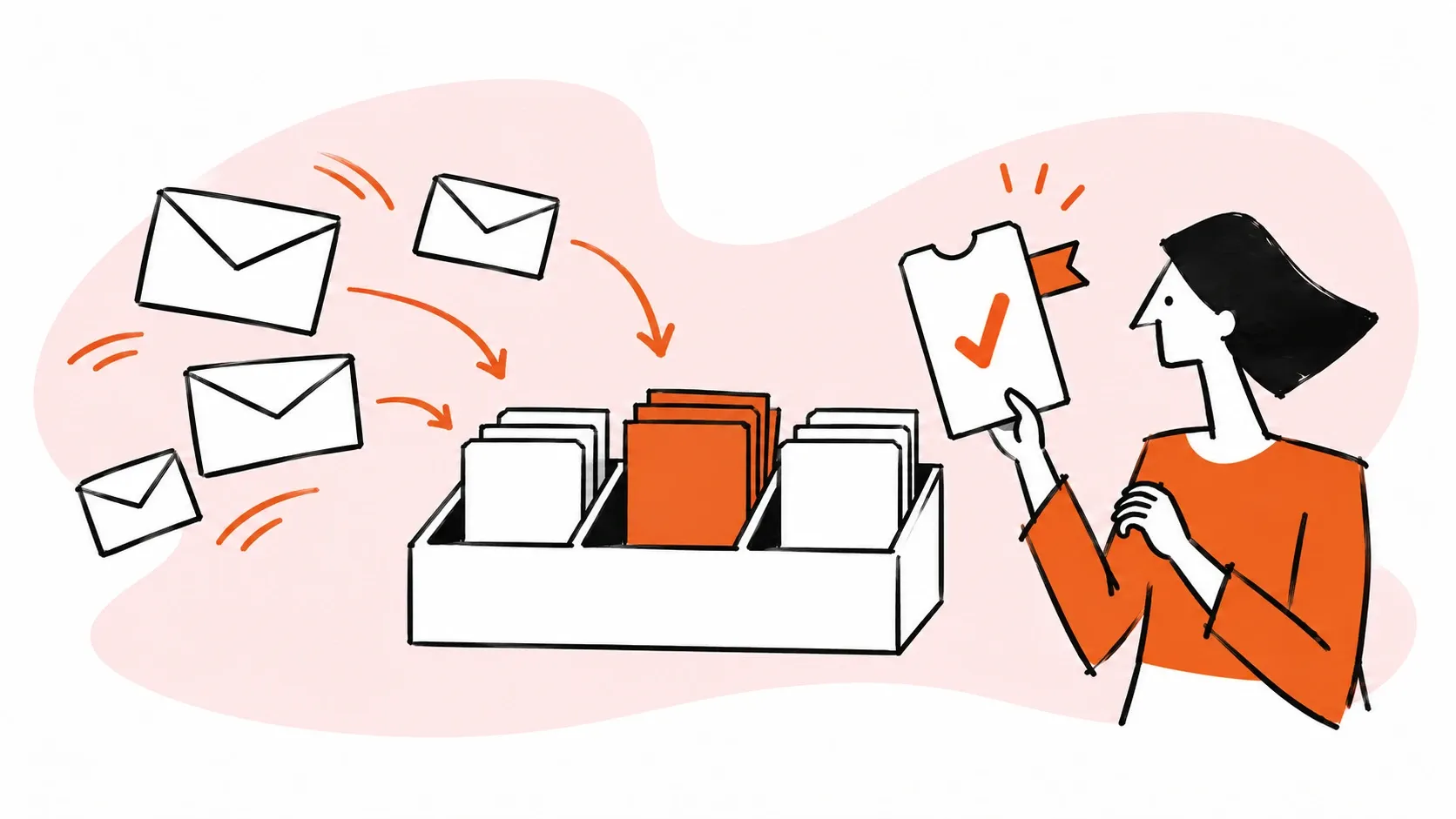
An email ticketing system turns messages sent to support@ into tickets with an owner, a status, and a shared history. Your team can see who owes the next reply, what is waiting on a customer, and which requests still need attention.
For a small business on Google Workspace, the best email ticketing system is usually one that works inside Gmail, so nobody has to learn a separate app. Keeping turns support@ email into tickets with an owner, a status, and collision detection, from $14 per user a month.
Best email ticketing systems at a glance
| Tool | Best for / workspace | Paid plan: monthly / annual | Ongoing free plan | Trial |
|---|---|---|---|---|
| Keeping | Small teams wanting a Gmail help desk | Essentials: $19 / $14 | No | 14 days |
| Hiver | Enterprises working in Gmail | Growth: $35 / $25 | No | 7 days |
| Gmelius | Collaboration and automation inside Gmail | Growth: $33 / $25 | No | 7 days |
| Help Scout | Small support teams happy in a separate app | Standard: $30 / $25 | 5 users, 1 inbox, 100 contacts/month | 15 days |
| Zoho Desk | Budget-conscious teams using a separate help desk | Express: $9 / $7 | 3 users | 15 days |
| Freshdesk | Teams building a dedicated support operation | Growth: $23 / $19 | None listed on pricing page | 14 days |
| Front | Teams collaborating across customer accounts in a separate app | Starter: $35 / $25 | No | 14 days |
| Zendesk | Structured support with room for more channels | Support Team: $19 billed annually ($25 monthly) | No | 14 days |
The email ticketing system that lives in Gmail
Keeping is an email ticketing system that is built into Gmail. No extra tabs or complicated software to learn.

What is an email ticketing system?
An email ticketing system converts incoming support emails into shared records your team can assign, prioritize, and resolve. Each email conversation keeps its messages, owner, status, and internal context together. Customers continue sending email, while agents use a managed queue to track unanswered requests and avoid conflicting replies.
A support ticket adds accountability to an email thread. An opened email is not necessarily handled. An assigned email has someone responsible for its next step. An urgent email can also be prioritized independently of when it arrived.
Email ticketing usually sorts requests into three statuses: open, pending while you wait for information, and resolved or closed. Internal notes preserve handoff context without copying the customer into the discussion. The software makes missed emails and duplicate work easier to spot, but your team still needs to use those controls consistently.
How email to ticket works
- Connect the address. Authorize a shared mailbox or configure forwarding according to the vendor’s setup instructions.
- Receive a request. A new customer email becomes a ticket, and later replies should join that conversation.
- Assign the work. Choose an agent manually or configure ticket routing rules. Keeping’s workflows and round robin support automation, with round robin on Advanced.
- Reply and track. The agent answers, updates the status, and leaves any internal handoff notes.
- Check the customer view. Send a test reply to an external address and confirm the sender, subject, attachments, and threading.
Customers generally receive ordinary email replies, but presentation varies. Some systems expose case numbers or reply markers. Keeping removes its internal ticket identifiers from customer-facing messages, even though agents can see an ID inside the tool.
Shared inbox vs email ticketing system
A shared inbox and an email ticketing system overlap when both offer ownership, statuses, and conversation history. The useful distinction is how much process you need around the email. A shared address alone gives access. Shared-inbox software can add ticketing controls, while a full help desk may manage additional channels and escalation rules.
| Question | Shared address alone | Shared inbox with ticketing | Broader help desk |
|---|---|---|---|
| Who owns the reply? | Team convention | Named agent | Agent or team, with routing options |
| What is outstanding? | Read flags or labels | Open, pending, closed views | Queues and configurable ticket states |
| Are deadlines tracked? | Manual follow-up | SLAs where the plan includes them | SLA policies vary by plan |
| Can managers measure work? | Manual counting | Response and workload reports | More detailed reports on higher tiers |
| What does the customer see? | Usually email, sometimes with a ticket ID | Email or other configured channels | |
| What must agents learn? | Existing mailbox habits | Assignment and collaboration controls | A separate support workspace |
For a small email-only team, a shared inbox with those controls may cover the whole requirement. A separate application becomes more attractive when your process depends on several channels, complex escalation, or reporting that your current plan cannot provide. Headcount alone is not a reason to move.
Google’s Collaborative Inbox supports taking, assigning, and completing conversations. Those actions happen in Google Groups. Our Google Groups collaborative inbox guide explains that option if basic coordination is enough and you can work there.
The 8 best email ticketing systems
These recommendations are based on each vendor’s published plans and documentation, checked September 29, 2026. The screenshots show each interface and may include features from higher plans. Start with the workspace your agents prefer, then compare the limits that affect your actual queue.
Keeping: for small teams working in Gmail
Keeping is our product. It’s first on this list because it’s built for small teams that work in Google Workspace. It adds a Gmail ticketing system around the shared address your customers already use. Agents can assign conversations, leave internal notes, and see teammate activity while answering in Gmail.
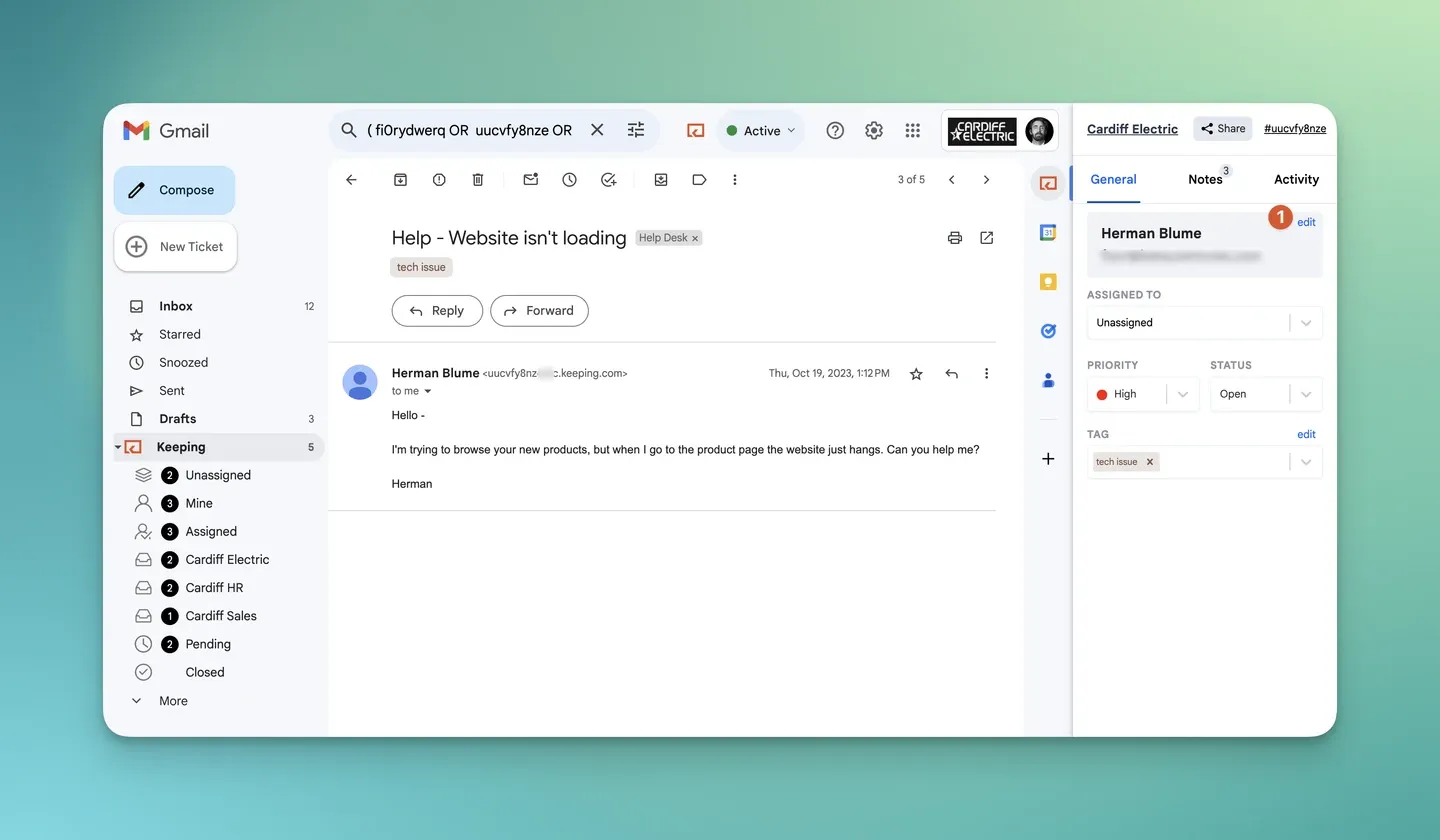
Source: Using Keeping in Gmail.
To assign a conversation, go to Keeping → Unassigned in Gmail, open the conversation, and choose an agent under Assigned to in the right sidebar. Then use the status control next to it to track the next step. By default, a reply closes the ticket and a customer reply reopens it. Mailbox settings can change that behavior.
Keeping pricing as of September 29, 2026: Essentials costs $19 per user a month, or $14 billed annually, with a 2-user minimum, 2 mailboxes, up to 10 agents, and 2 workflows. Advanced is $29, or $24 billed annually.
Give every support@ email an owner and a status without leaving Gmail. Start a free trial for 14 days, with no credit card required.
Hiver: for enterprises working in Gmail
Hiver in Gmail is best for enterprises that want email ownership plus a wider set of service workflows inside Gmail. Its Chrome extension provides shared inboxes, assignments, and conversation history. Growth includes rule-based automation and prebuilt analytics. Pro adds SLAs and advanced analytics.
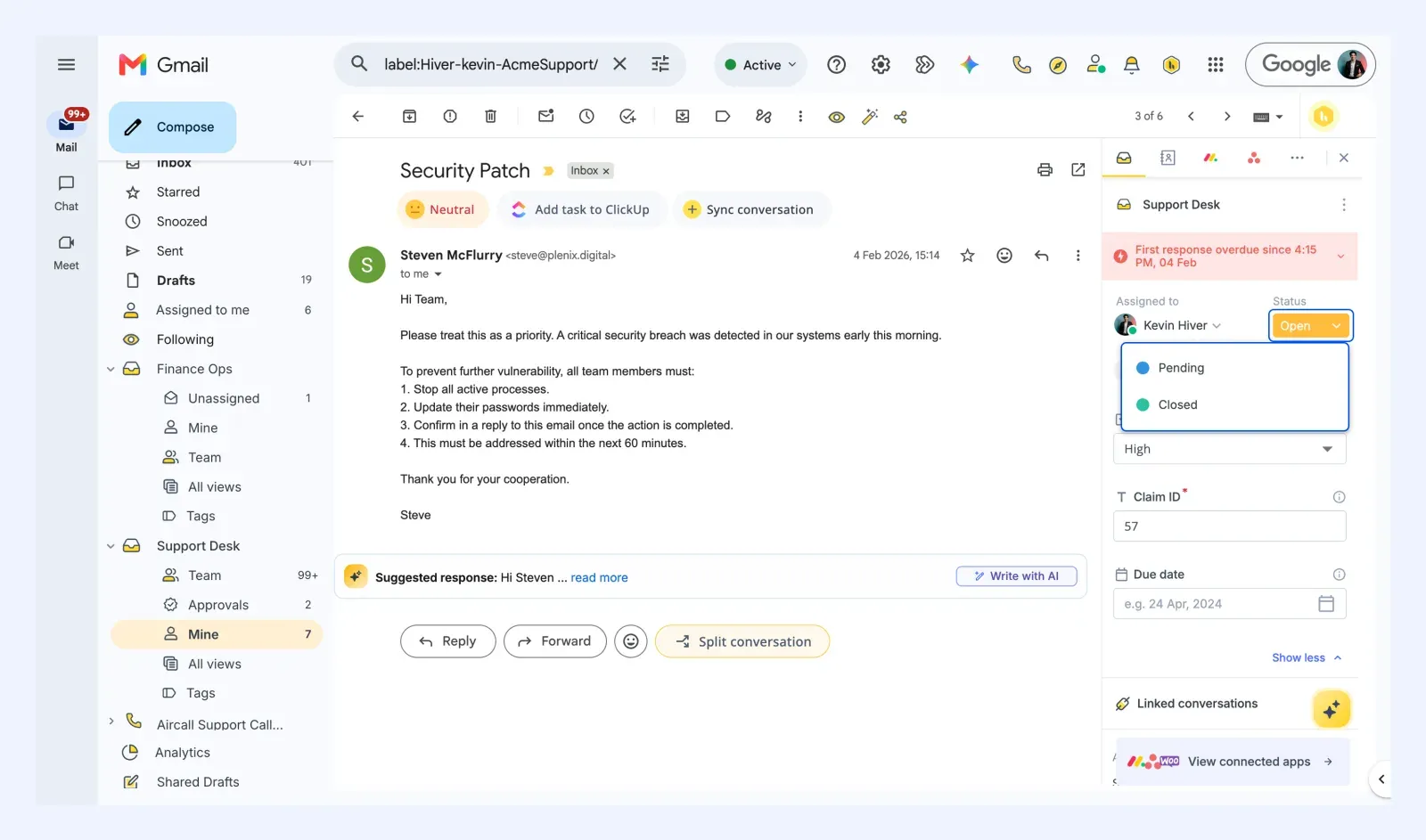
Source: Hiver’s Managing email conversations documentation.
Hiver comes in two editions, so check which one you’re looking at. Hiver in Gmail works inside your inbox, and Hiver Omni is a separate workspace. A demo of Omni won’t tell you much about how day-to-day work feels in Gmail, so ask to see the edition you plan to buy.
The trade-off is seat packaging. Plans start at two seats, then move to five and increments of five. A three-person team can therefore pay for five seats. Growth also caps users at ten and shared inboxes at two, so compare a Hiver alternative against the Hiver plan your team would actually need.
Hiver in Gmail pricing, checked September 29: Growth is $35 per user a month, or $25 billed annually. The 7-day trial uses Elite features, so check that your must-haves are still available on Growth afterward.
Gmelius: for collaboration and automation in Gmail
Gmelius suits teams that want Gmail collaboration with more automation around incoming email. Its shared inboxes combine assignment, conversation statuses, and views for unassigned, pending, and closed work. Its board view also lets you distribute conversations by dragging cards into a teammate’s column.
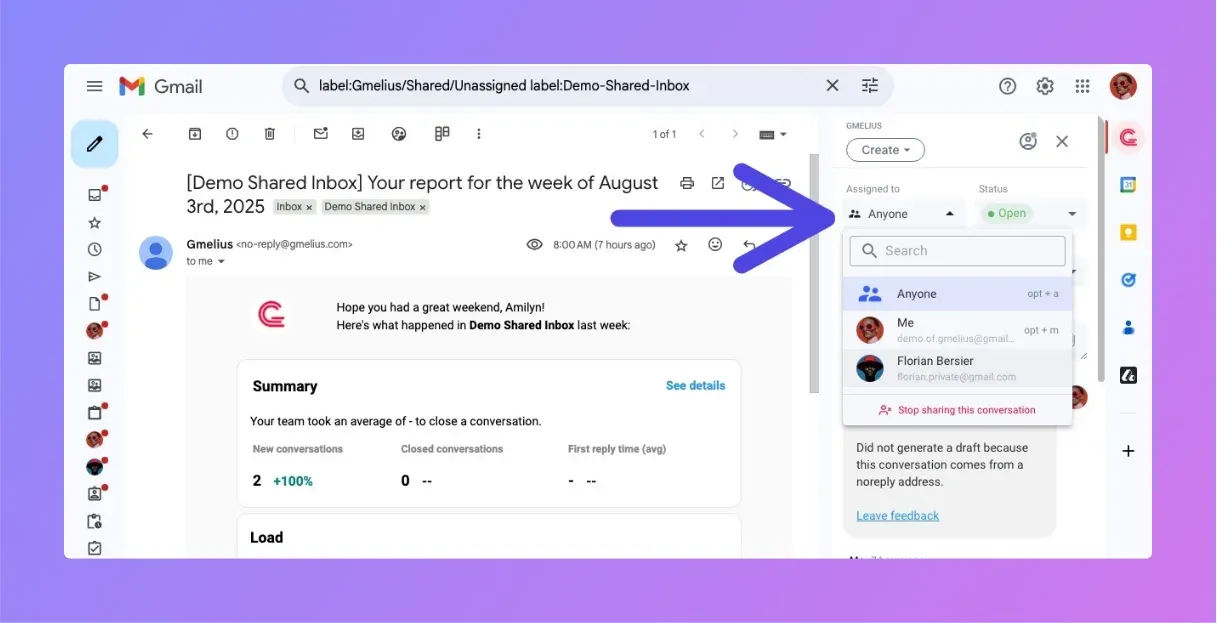
Source: Gmelius shared-inbox documentation.
That flexibility is useful when sales and support share similar email processes. A manager can evaluate how work moves between owners instead of only checking whether the inbox is empty. Start with one shared address and one assignment rule before reproducing every process your team currently runs in spreadsheets.
The pricing trap: Meli is the cheaper AI-assistant entry plan, not the shared-inbox package used in this comparison. Growth includes unlimited shared inboxes, automatic assignments, shared templates, and SLA/email analytics, with a 50-user limit. Our Gmelius alternative comparison helps assess whether that broader package matches your requirements.
Gmelius pricing, checked September 29: Growth is $33 per user a month, or $25 billed annually. Meli is $21, or $19 billed annually. The Growth trial lasts 7 days, so give your evaluators a handoff and a pending conversation to work through during that window.
Help Scout: for a small standalone support team
Help Scout is a good shortlist option for a small support team that wants a dedicated application. Its shared inbox gives agents an assigned queue and conversation context, while saved replies and workflows help with recurring requests. Customers can continue emailing your support address even though your team answers somewhere else.
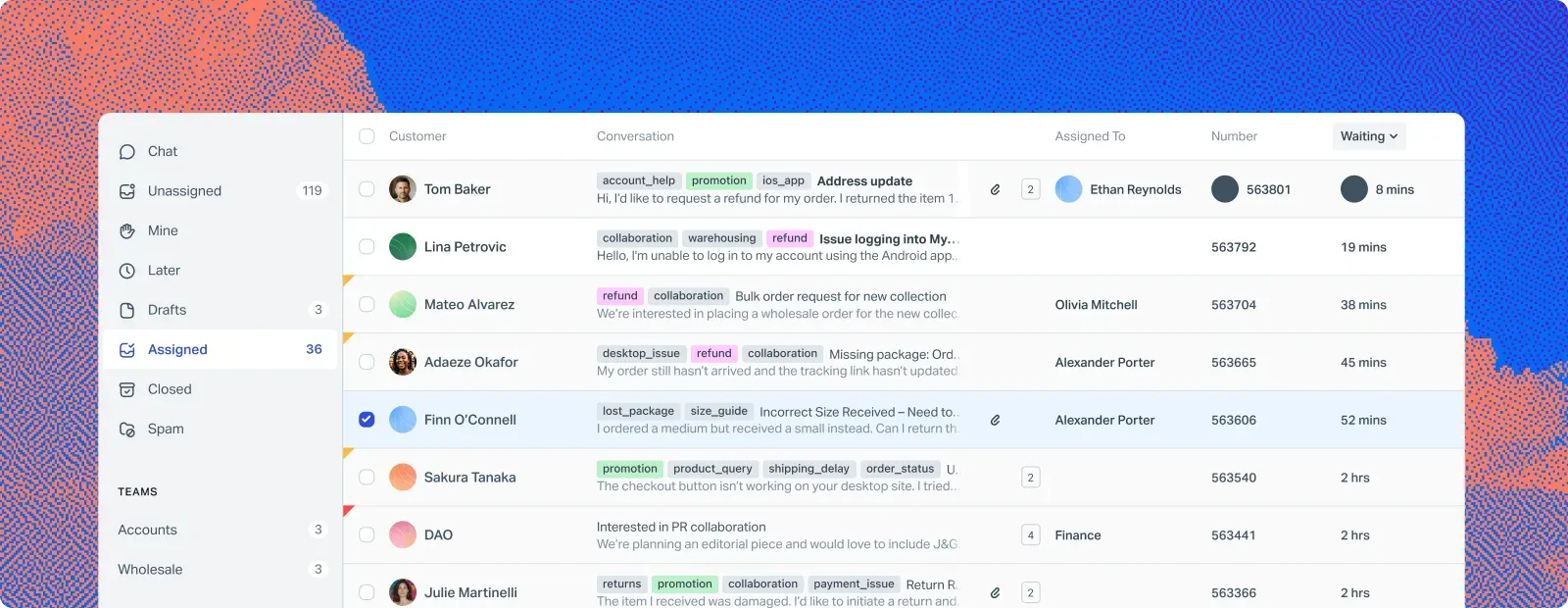
Source: Help Scout’s shared inbox page.
The separate workspace is a deliberate choice. A support team may appreciate having its queue away from personal email. Colleagues who answer only occasionally may prefer a Help Scout alternative inside Gmail. Let those occasional responders participate in the trial, too.
Watch the free-plan contact cap. Free includes five users and one inbox, but only 100 contacts per month. Help Scout counts people who receive a reply or have a question resolved by its AI assistant, so five seats do not imply unlimited support volume.
Help Scout pricing, checked September 29: Standard costs $30 per user a month, or $25 billed annually, and includes two inboxes. Its 15-day trial covers paid features, so test the free plan separately if that is what you intend to keep.
Zoho Desk: for a lower entry price
Zoho Desk offers the lowest paid entry price in this eight-tool comparison, and a free option for three users. It is a separate help desk: incoming email becomes a ticket with an owner and properties, rather than adding a sidebar to each agent’s Gmail.
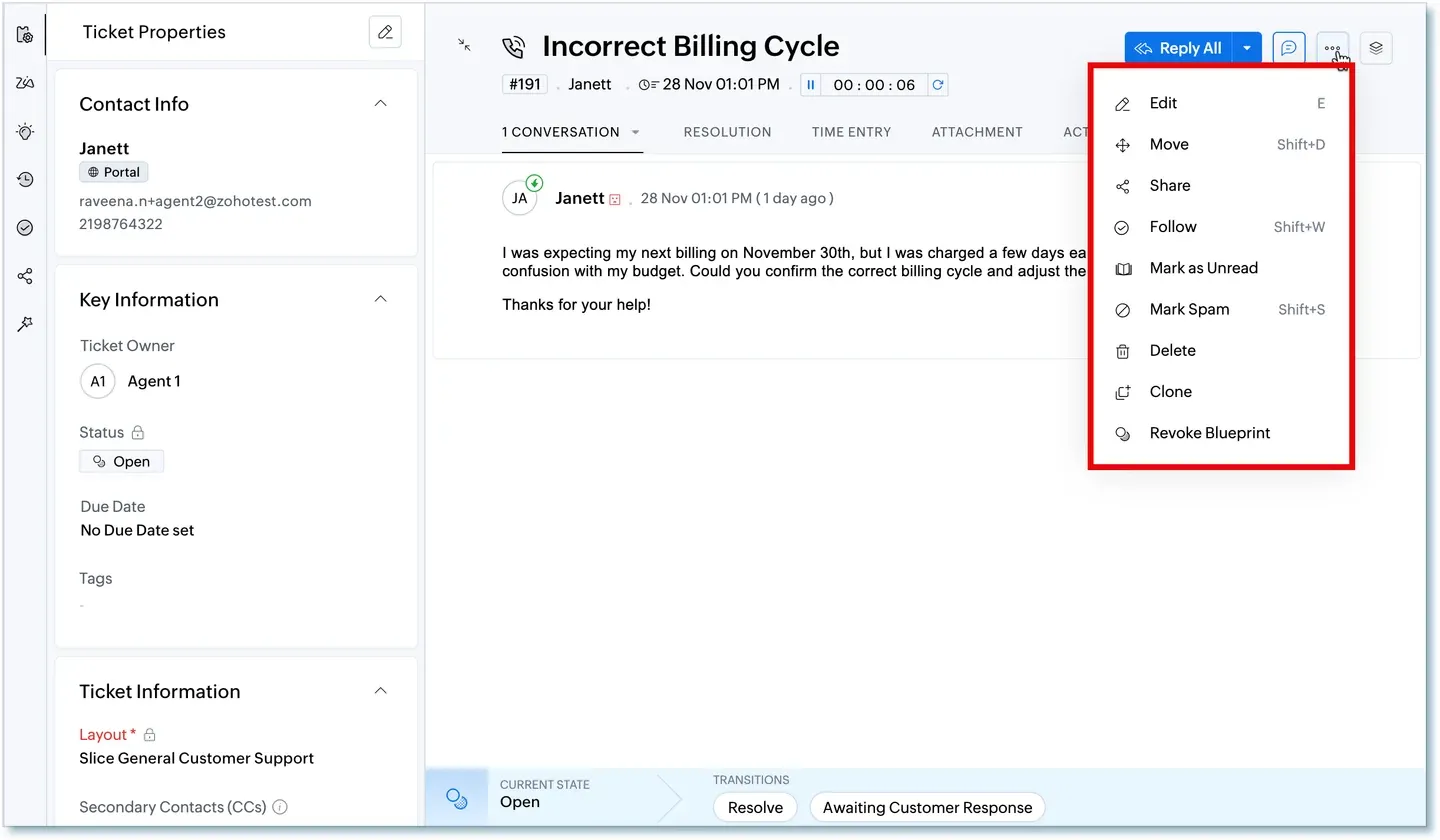
Source: Zoho Desk’s ticket-detail documentation.
Express includes email handling, direct assignment, and workflows. You forward customer messages into the desk and use views to organize the resulting queue. That makes it worth testing when budget matters more than preserving the Gmail interface.
The trade-off is configuration and plan selection. The wider product offers more channels and automation than its cheapest tier. Write down the workflow you need before assuming the low entry price covers it. Our Zoho Desk alternative comparison focuses on the choice between that separate desk and working in Gmail.
Zoho Desk pricing, checked September 29 in USD: Express is $9 per user a month, or $7 billed annually. Standard is $20, or $14 billed annually. The trial lasts 15 days. Regional prices differ, so select your billing currency before approving the budget.
Freshdesk: for a dedicated support operation
Freshdesk is a strong candidate when you want to build a dedicated support operation around email tickets. Growth combines ticketing, a shared inbox, a customer portal, a knowledge base, and reporting. Agents work in Freshdesk, with conversation details and ticket properties together.
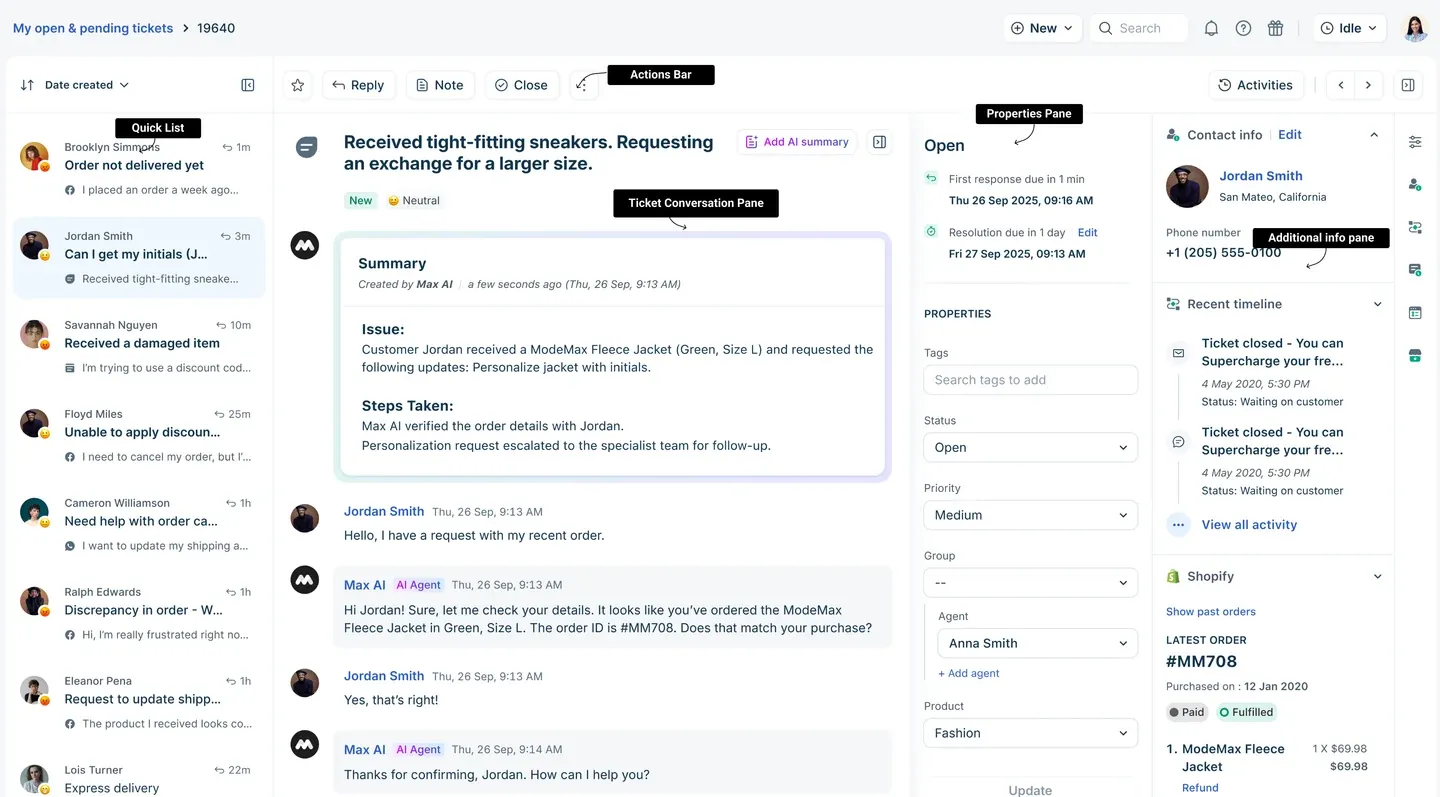
Source: Freshdesk’s ticket-details guide. The screenshot includes additional configured features.
The useful distinction is the work surrounding each reply. Internal threads and linked tasks can help when a request needs input from several people. Include one of those cases in your trial, alongside the simple password-reset emails, to see whether the dedicated workspace earns its place.
The downside is buying more process than you need. A team that mainly wants ownership and notes inside Gmail should compare a Freshdesk alternative before committing to a new application. Also check the plan matrix for routing, SLA policies, and AI usage instead of assuming the full product demonstration is included.
Freshdesk pricing, checked September 29: Growth costs $23 per agent a month, or $19 billed annually. There is a 14-day trial. The current pricing page lists Growth, Pro, and Enterprise, so we do not count Freshdesk as an ongoing free option.
Front: for collaborative account conversations
Front is built around collaborative customer conversations in a separate workspace. Assignment, internal comments, and shared drafts help teammates coordinate a reply. It is worth evaluating when several people contribute to an account relationship and the email history matters beyond the support queue.
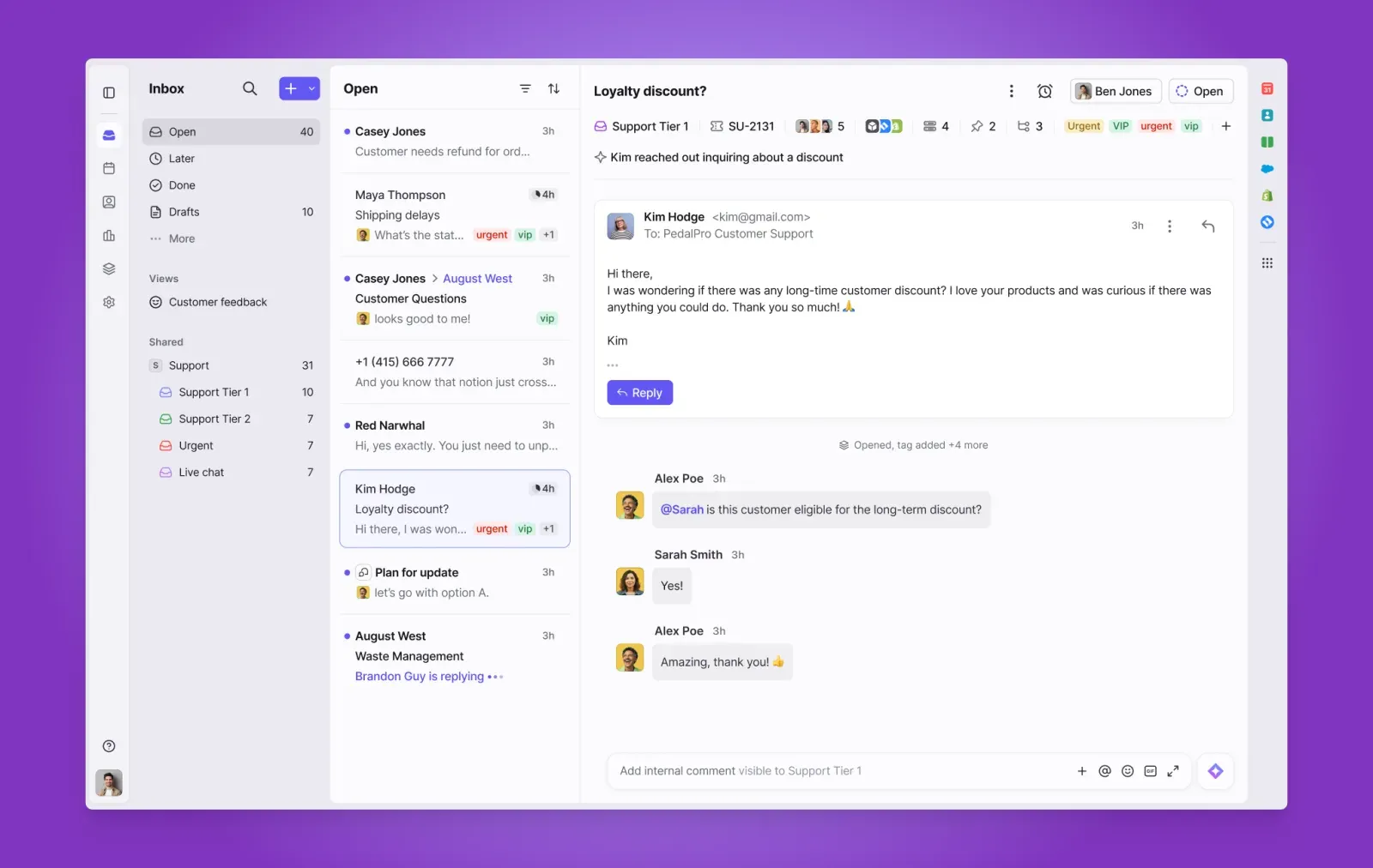
Source: Front’s published product assets.
Starter provides shared inboxes, ticketing, basic analytics, and up to ten automation rules. That can cover an email-focused team, but it is not the same package as Front’s broader omnichannel offering. Before moving, compare the everyday handoff with a Front alternative that fits your team’s current email habits.
The important limit: Starter supports one channel type and up to ten seats. Professional adds omnichannel support and more advanced reporting. A team can need that upgrade because of its workflow even before it reaches the seat cap.
Front pricing, checked September 29: Starter is $35 per seat a month, or $25 billed annually. Professional is $85, or $65 billed annually. Front offers a 14-day trial with no card required. Use it to check which plan includes the channels and controls you tried.
Zendesk: for structured support across channels
Zendesk belongs on the shortlist when email is part of a more structured support operation. Support Team provides the email-focused starting point. The broader Suite and Agent Workspace support work across channels, with customer context and interaction history beside the conversation.
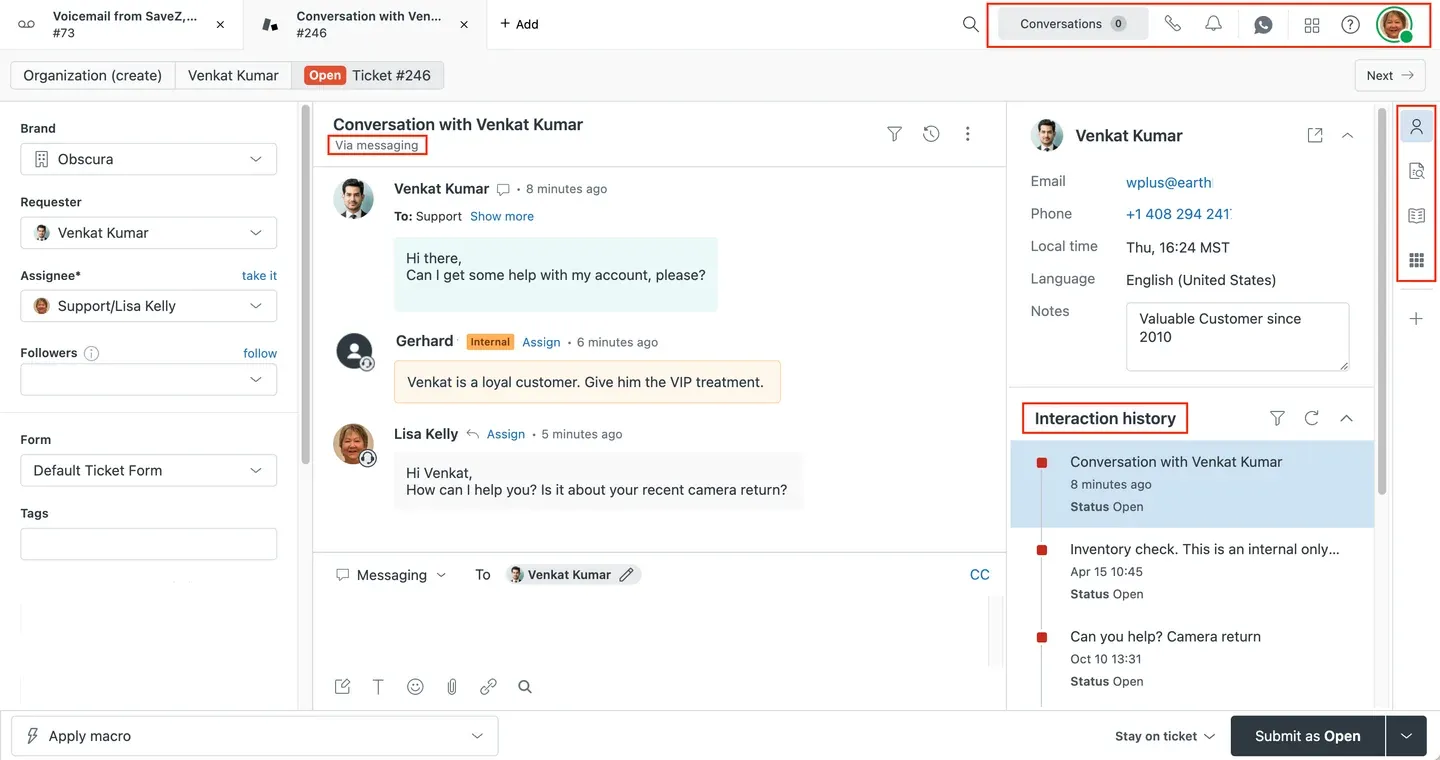
Source: Zendesk Agent Workspace documentation. The screenshot shows a messaging conversation in the broader Agent Workspace, which goes beyond the email-focused Support Team plan.
The trade-off is the gap between entry price and required scope. One small team may need only email ticketing. Another may need messaging, voice, or more complex routing. Price the actual plan and implementation work instead of choosing from the lowest number on the page, as our Zendesk vs Help Scout comparison does for a small email team.
Zendesk’s biggest competitor depends on the team. Freshdesk is another dedicated-desk option on this list, and a Gmail team should also consider a Zendesk alternative built around its inbox.
Zendesk pricing, checked September 29: Support Team starts at $19 per agent a month billed annually ($25 monthly). Suite Team starts at $55 billed annually ($69 monthly). The 14-day trial shows broader Suite capabilities, so confirm your intended plan’s limits afterward.
How we chose and ranked these tools
We grouped tools by where agents work, putting Gmail options first because this guide is for small Google Workspace teams. Within each group, the order reflects our judgment about small-team fit, not a price ranking. Keeping comes first because it is our product and serves that reader.
We compared vendor pricing pages and documentation for email handling, workspace, setup requirements, entry-plan costs, and limits. We did not run the same hands-on test across all eight products.
We left four tools off the list, and all four can handle email. HubSpot is CRM-first, which makes it a different buying decision. Jitbit and self-hosted options are covered in simple ticketing systems. HappyFox is another standalone desk, and LiveAgent leans toward live chat and calls.
What to look for in email ticketing software
Choose an email ticket management system by running one real request through it, from arrival to follow-up. Use the same scenario for each finalist: a customer sends an urgent billing question, the first agent needs a colleague’s answer, and the customer replies after the ticket is closed.
- Ownership and routing: Can you see the unassigned queue and name one responsible agent? Start with a clear ticket triage process before adding assignment rules.
- Statuses and priorities: Can agents distinguish work awaiting them from work awaiting the customer? Agree what “pending” means and when a request becomes urgent.
- Collaboration: Check internal notes, teammate activity, and templates. Collision detection helps prevent duplicate replies only if agents notice and respond to it.
- Deadlines and reporting: Compare the plan’s SLA metrics, business-hour handling, and response reports. Then check how it reports SLA compliance when a deadline is missed. An attractive dashboard is not enough if it measures a different deadline from the one you promise. If your targets aren’t written down yet, start with this SLA template.
- Organization: Choose a small set of ticket categories and test a handoff. Keep the help desk workflow simple enough for occasional responders.
- Customer experience and access: Check the sender address, ticket identifiers, attachments, and mobile workflow. Test customer replies after closure and confirm they return to the right queue.
Before rollout, name the person responsible for checking unassigned work each day. The software shows the queue, but someone still needs to act on it. Record which trial features belong to your chosen plan so the workflow does not break when the trial ends.
Free email ticketing systems
Help Scout and Zoho Desk offer ongoing free plans for small teams, with different limits. Help Scout suits up to five users handling a small contact volume, and Zoho Desk supports three users. Choose by the constraint you will reach first: people, inboxes, or customer volume. A temporary trial is not a free plan.
As of September 29, 2026, Help Scout Free includes one inbox and 100 contacts per month. Zoho Desk’s Free edition allows three users. HubSpot also advertises free ticketing tools if you want ticket records alongside CRM data.
Freshdesk’s current pricing page does not list a free plan. For self-hosted or open-source approaches, compare simple ticketing systems and include hosting and maintenance in your budget.
Which one should you pick?
For a Google Workspace team that wants to keep answering in Gmail, start with Keeping. For a small team comfortable moving into a separate app, compare Help Scout and Zoho Desk. Bring Freshdesk, Front, and Zendesk into the evaluation when your process needs the broader workspace they offer.
Shortlist two tools and test the same mailbox, handoff, and customer follow-up in each. Compare the price after the trial, including seat minimums and the tier required for your automation.
If Gmail is where your team wants to work, give every support@ email an owner and a status. Try Keeping free for 14 days, with no credit card required.
For setup options, see how to turn Gmail into a help desk and our guide to choosing a Google ticketing system.
Frequently asked questions about email ticketing systems
What is an email ticketing system?
An email ticketing system turns incoming customer emails into trackable conversations with an owner, status, and shared history. It helps a team see who should reply and which requests remain open. Customers can keep using email while agents coordinate the work, either inside Gmail with an extension or in a separate support application.
What is the best free email ticketing system?
Help Scout Free is worth considering for up to five users with a low contact volume, while Zoho Desk Free supports three users. As of September 29, 2026, Help Scout limits Free to one inbox and 100 contacts per month. The best choice depends on which limit your team will reach first.
Can Gmail become an email ticketing system without moving tools?
Yes. Keeping, Hiver in Gmail, and Gmelius add ticket ownership and statuses while agents continue working in Gmail. You still need to connect the shared address, configure access, and learn the collaboration controls. Staying in the same interface reduces the change in daily habits, but it does not remove the need for setup.
Does Gmail have an email ticketing system?
Gmail alone does not provide a complete shared ticket workflow with agent ownership and ticket statuses. You can add those controls with a Gmail extension, or use Google Groups Collaborative Inbox for assignment and completion in Groups. Choose based on whether your team wants to handle the queue inside Gmail or in another interface.
Does Outlook have email ticketing?
Outlook teams can connect email to a separate ticketing application. Keeping works inside Gmail and does not support Outlook.